Why Does My Breaker Keep Tripping?
You are halfway through making dinner when everything on one side of the house goes dark. The hair dryer running down the hall, the microwave you just started, and the kitchen lights all cut out at once. You head to the panel, flip the tripped breaker back on, and things come back to life. But if it keeps happening, the breaker is not malfunctioning: it is responding to a real condition in your circuit, and understanding which condition tells you exactly what to fix.
The short version
- Overloaded circuit: Too many devices drawing more amps than the breaker allows, the most common cause.
- Short circuit: Hot and neutral wires touch, causing a sudden surge of current.
- Ground fault: Current is flowing somewhere it shouldn't, like through a damaged cord or wet outlet.
- Weak breaker: Old or faulty breakers can trip at lower loads than their rating.
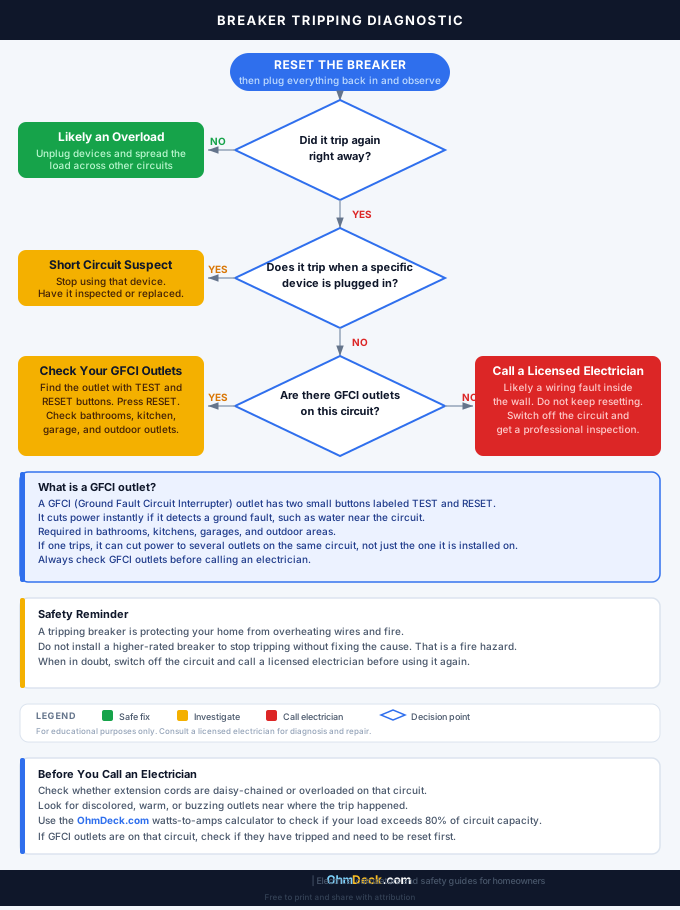
If resetting fixes it temporarily but it trips again: you have an overload. If it trips immediately every time: suspect a short or fault. Either way, keep reading.
Is too much plugged into one circuit?
Every circuit breaker has a current rating, typically 15 A or 20 A for household circuits. When the total current drawn by everything plugged into that circuit exceeds the breaker's capacity, the breaker heats up and trips to prevent the wiring from overheating.
This is not a malfunction, it is the breaker doing exactly what it is supposed to do. The problem is too many devices on one circuit, or one high-draw device pushing the circuit past its limit.
How to identify it: The breaker trips only when you run several appliances at once, or only when a specific high-wattage device is on. It resets cleanly and stays on until you repeat the overload.
What to do: Move high-draw devices to a different circuit, unplug things you don't need running at the same time, or consult an electrician about adding a dedicated circuit for the heavy loads.
You can calculate total load using the watts-to-amps calculator and compare against the circuit's safe sustained limit (80% of breaker rating).
Does the breaker trip the instant you reset it?
A short circuit happens when the hot wire (black) makes direct contact with the neutral wire (white) in a way that bypasses resistance entirely. This creates a massive current spike, far beyond the breaker's rating, and the breaker trips instantly to protect the wiring.
How to identify it: The breaker trips immediately when you plug in a specific device or flip a switch. You may notice a burning smell, visible scorching on an outlet, or a popped GFCI. Simply resetting the breaker will not help; it will trip again right away.
Common causes: A worn or damaged appliance cord, a loose wire connection inside an outlet or switch, or wiring damage from pests, staples, or old insulation.
What to do: Unplug everything from the circuit. If the breaker holds after unplugging, test devices one at a time to find the culprit, then repair or replace the damaged device. If the breaker still trips with nothing plugged in, the short is in the wiring itself; call a licensed electrician.
Is the tripping happening near water?
A ground fault is similar to a short circuit, but the unintended current path is to ground rather than neutral. This can happen when a hot wire touches a grounded metal surface, when water gets into an outlet, or when damaged insulation allows current to flow where it shouldn't.
GFCI outlets and GFCI breakers are designed to catch ground faults at very low current levels (5 mA) and trip before there's risk of shock. If a GFCI outlet trips and won't reset, a ground fault in the circuit is the likely cause.
How to identify it: Breaker or GFCI trips near damp areas (bathroom, kitchen, garage, outdoors), or when a specific device with damaged wiring is plugged in.
What to do: Remove potential sources of moisture and test each device individually. Damaged power cords or tools should be repaired or replaced. Persistent tripping with no obvious cause warrants professional inspection.
Could the breaker itself be the problem?
Breakers are mechanical devices and they wear out over time. A breaker that has tripped hundreds of times can lose calibration and begin tripping at lower current levels than its rating. Very old breakers (30+ years) are also worth having inspected.
If you have ruled out overloads, short circuits, and ground faults, and the circuit trips under loads that should be well within its rating, the breaker itself may need replacement.
What to do: Have a licensed electrician evaluate the breaker and replace it if needed. Do not attempt to replace a main panel breaker yourself unless you are qualified, the main lugs in a panel remain live even with the main breaker off.
What is your tripping pattern telling you?
| Tripping pattern | Most likely cause | First step |
|---|---|---|
| Trips after running multiple devices | Overloaded circuit | Reduce load, move devices to another circuit |
| Trips immediately on reset | Short circuit in wiring | Unplug everything, call electrician if still trips |
| Trips when specific device is plugged in | Short circuit in device | Repair or replace the device |
| Trips near water/damp area | Ground fault | Check for moisture, inspect cords and connections |
| Trips under light load for no clear reason | Weak or aging breaker | Have electrician test and replace breaker |
Related tools and guides
- Watts-to-Amps Calculator, check if your load exceeds circuit capacity
- Extension Cord Size Calculator, check whether a long temporary cord is too light for the load
- Can You Run a Space Heater on an Extension Cord?, one of the most common high-draw overload setups
- 100 ft Extension Cord Voltage Drop, see when a long cord adds enough resistance to weaken the setup
- How Many Watts Is a 15 A Circuit at 120 V?
- How Circuit Breakers Work
- Can I Upgrade a 15 A Breaker to 20 A?
- Electricity Basics
FAQ
Is it safe to keep resetting a tripping breaker?
It depends on why it is tripping. Resetting a breaker that tripped from an overload, after you have reduced the load, is generally fine. Repeatedly resetting a breaker that trips from a short circuit or ground fault without fixing the underlying issue can be dangerous. If the cause is unknown or the breaker trips again immediately, stop resetting and investigate or call an electrician.
Can I just use a higher-rated breaker to stop the tripping?
No. The breaker is sized to protect the wiring, not the devices. If the breaker is tripping, it means the wiring is being asked to carry more current than it was designed for. Installing a higher-rated breaker removes that protection without fixing the underlying problem. The fix is either reducing the load or upgrading the wiring, not upsizing the breaker alone. See Can I Upgrade a 15 A Breaker to 20 A?
My breaker trips only at night. What causes that?
Thermal tripping from accumulated heat is one cause, a circuit that runs near its limit all day can trip as internal heat builds up, even if the current is technically within rating. Another cause is devices with different behaviors at night (e.g., HVAC compressors, dehumidifiers, certain refrigerators cycling at higher loads). Check what runs at the time of tripping and calculate the total current draw.
How do I know which circuit is tripping?
Look at which outlets and lights go out when the breaker trips, they are all on the same circuit. Find the corresponding breaker in your panel (it will be the only one in a middle position, not fully on or fully off). Label your breakers if they aren't already, this makes future troubleshooting much faster.
When should I call an electrician instead of troubleshooting myself?
Call a professional if: the breaker trips with nothing plugged in (wiring fault), you see scorching or smell burning from outlets or the panel, the panel itself feels warm, you cannot identify the cause after basic troubleshooting, or you need to do any work inside the panel. Outlets, plugs, and devices are generally safe for a reasonably handy homeowner to inspect, wiring inside walls and panels is not.
Disclaimer: Results are informational estimates for learning and planning only. Always follow the applicable electrical code and consult a qualified licensed electrician for safety-critical work.