Electricity Basics: Voltage, Current, and Resistance
On This Page
- Common household values
- Power, current, voltage, and resistance
- The formulas: P, V, I, R
- Worked examples
- AC vs. DC
- Common mistakes
- FAQ
Use this guide for learning and planning estimates only, not as a substitute for code compliance, field measurements, or licensed professional judgment.
How Electricity Gets Into Your Home and What Happens Next
Before 1880, homes were lit by candles and gas lamps. Then in 1882, Thomas Edison flipped a switch on Pearl Street in New York City and powered 85 buildings — the world's first commercial electrical grid. Within a decade, electric lights were spreading through cities. By the mid-1900s, electricity had become the invisible backbone of everyday life.
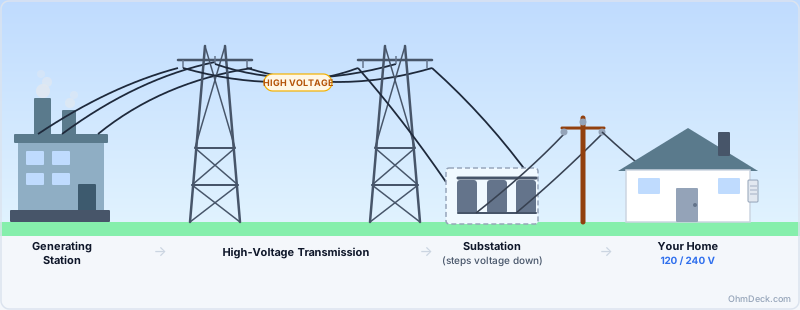
Today you flip a switch without thinking twice. But behind that switch is a remarkable journey. Electricity travels from a generating station hundreds of miles away, down high-voltage transmission lines, through a local substation that steps the voltage down to safer levels, along your neighborhood's distribution lines, and finally into your home through a meter on the side of the building. Understanding even a little of that journey makes the numbers — voltage, amps, watts — a lot less abstract.
The electrical panel: your home's nerve center
After the meter, electricity lands in your electrical panel (also called the breaker box or load center). This is where the full power of your service gets divided into individual circuits that run through your walls.
At the top of the panel sits the main breaker, typically rated 100A, 150A, or 200A depending on the home. This is the maximum current the whole house can draw at once. Below it are the individual circuit breakers, each protecting one circuit. Common ratings are 15A for lighting and general outlets, and 20A for kitchens, bathrooms, and the garage. Larger appliances get their own dedicated circuits: 30A for a dryer, 50A for an electric range.
Every circuit leaves the panel on two wires (hot and neutral) and returns. A third wire, the ground, is a safety path that only carries current if something goes wrong. The panel runs at 120/240V in North America. Most of your outlets use 120V. Heavy appliances like dryers, ovens, and EV chargers use 240V, formed by combining two 120V legs from the panel.
Outlets, switches, lights, and appliances
From the panel, circuits branch out through the walls to every device in the house. A standard North American outlet delivers 120V through a hot slot, a neutral slot, and a round ground hole. Plug in a device and you complete the circuit — current flows and your device runs. GFCI outlets, the ones with the test and reset buttons, add a fast safety shutoff and are required near water sources like sinks, bathrooms, and garages.
A light switch does something even simpler: it opens or closes the hot wire on a lighting circuit. Open means no current flows and the light is off. Close means current flows and the light turns on. The switch itself consumes no meaningful power. The light fixture does, though far less than you might expect with modern LEDs. A 60-watt equivalent LED bulb draws only 8 to 10 watts, which is less than 0.1 amps. Old incandescent bulbs used 60 watts or more to produce the same light, so switching to LED makes a real dent in a circuit's total load.
Appliances are where current adds up fast. A space heater, a hair dryer, or a microwave can each draw 10 to 15 amps on their own. Running several of them on the same circuit is what trips breakers. The breaker senses too much current, heats up, and trips before the wire does. That is its entire job: protect the wiring, not the device.
Now that you know how electricity flows through your home, here is how the numbers behind it work.
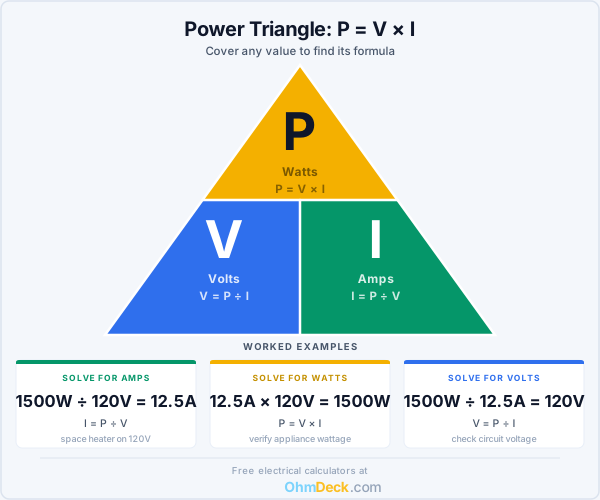
Formula Symbols (Quick Reference)
- P = Power (watts)
- I = Current (amps)
- V = Voltage (volts)
- R = Resistance (ohms)
Common Household Values (Sanity Checks)
These typical ranges give you a feel for real-world numbers before you start calculating.
| Item | Typical value | Quick note |
|---|---|---|
| Wall outlet (North America) | 120V | Standard residential branch circuits |
| Wall outlet (most other regions) | 230V | Common international residential voltage |
| Space heater | 1,500W (~12.5A @120V) | Near the limit of a 15A circuit |
| Hair dryer | 1,500 to 1,875W | High-draw appliance |
| Phone charger | 5 to 30W | Low-power electronics range |
| LED bulb | 8 to 12W | Much lower draw than old incandescent |
| Microwave | 900 to 1,500W | Can cause noticeable current spikes |
| Electric dryer | 4,000 to 5,500W | Needs a dedicated 240V / 30A circuit |
| Electric range | 8,000 to 14,000W | Dedicated 240V / 50A circuit |
Always check the device label. Nameplate values are your most reliable reference.
Power, Current, Voltage, and Resistance: What They Actually Mean
Every circuit and every appliance in your home can be described by four numbers. Here is what each one means in plain terms.
Power (P): the watts on the label
Power is the rate at which a device uses energy, measured in watts (W). It is the number you see on lightbulbs, appliances, and your electricity bill. A 1,500W space heater consumes energy fifteen times faster than a 100W lightbulb. Power is what you pay for, and it is the most practical number to start with as a homeowner.
- LED bulb: 8 to 12W
- Phone charger: 5 to 30W
- Microwave: 900 to 1,500W
- Space heater: 1,500W
- Electric dryer: 4,000 to 5,500W
Current (I): the flow
Current is the movement of electrical charge through a circuit, measured in amps (A). It only flows when there is a complete path. Current is the number that determines wire sizing and breaker ratings. High current means heat, and too much heat means a tripped breaker or a dangerous situation.
- LED bulb: less than 0.1A
- Phone charger: ~0.5 to 2A
- Space heater: ~12.5A
- Most home circuits are rated 15A or 20A
Voltage (V): the pressure
Voltage is the electrical force that drives current through a circuit, measured in volts (V). Think of it like water pressure in a pipe. Your wall outlet in North America provides 120V. That pressure is always present whether anything is plugged in or not.
- AA battery: ~1.5V
- Car battery: ~12V (nominal)
- Standard outlet: 120V (North America)
- Heavy appliance outlet: 240V
Resistance (R): the restriction
Resistance is how much a component or material opposes current flow, measured in ohms (Ω). Heating elements and motor windings have high resistance by design. Good wiring has very low resistance, but corroded connections or loose terminals add unwanted resistance that turns into heat.
The Formulas: How P, V, I, and R Connect
These four values are linked by two simple relationships. For most homeowners, the power formula is the one you will use most often.
The power formula (most useful for homeowners)
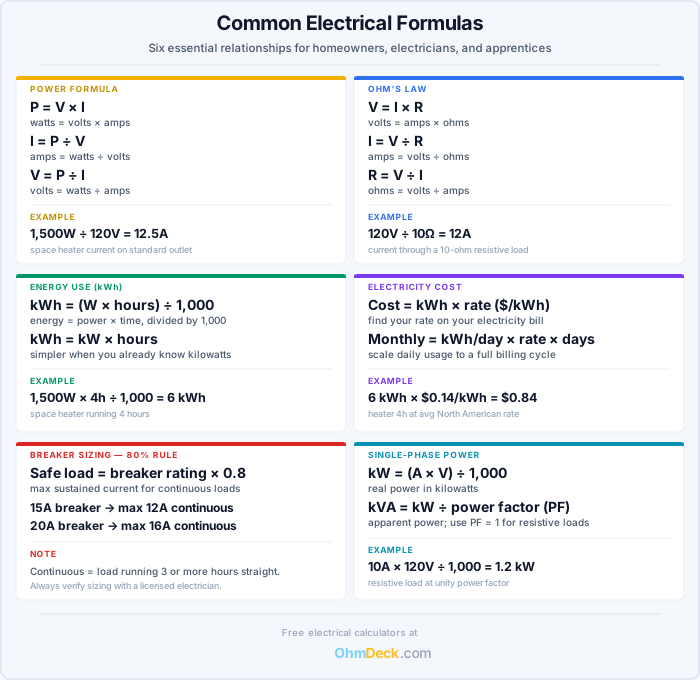
P = V × I— know volts and amps, find wattsI = P ÷ V— know watts and volts, find ampsV = P ÷ I— know watts and amps, find volts
The most common question homeowners ask is: how many amps does this appliance draw? That is I = P ÷ V. Use the Amps to Watts Calculator to check it quickly.
Ohm’s Law (for resistance and circuit calculations)
V = I × R— know amps and ohms, find voltsI = V ÷ R— know volts and ohms, find ampsR = V ÷ I— know volts and amps, find ohms
Need to solve for voltage, current, or resistance? Use the Ohm’s Law Calculator.
Three Worked Examples Using Real Appliances
Example A: How many amps does a space heater draw?
A 1,500W space heater is plugged into a standard 120V outlet. How many amps does it draw?
I = P ÷ V = 1,500 ÷ 120 = 12.5A
A 15A circuit is nearly full with just that one heater. Adding a second device on the same circuit will very likely trip the breaker.
Example B: How many watts is your microwave actually using?
Your microwave draws 9A from a 120V outlet. What is its power consumption?
P = V × I = 120 × 9 = 1,080W
That is just over 1kW. Running it for one hour uses roughly 1kWh of electricity, which you can price out with the Electricity Cost Calculator.
Example C: What circuit does an electric dryer need?
An electric dryer is rated at 5,000W on a 240V circuit. What current does it draw?
I = P ÷ V = 5,000 ÷ 240 = 20.8A
A standard 30A dedicated circuit gives adequate headroom. A 20A circuit would not be sufficient for continuous operation.
AC vs. DC (The Quick Version)
The electricity from your wall is AC (alternating current). The voltage reverses direction 60 times per second (60Hz in North America, 50Hz in most other countries). That is how the utility grid works; AC transmits efficiently over long distances.
Batteries are DC (direct current), a steady one-direction flow. Most electronics convert AC to DC internally using a built-in power supply.
For most beginner calculations you can treat your home circuits as if the numbers are steady. The power formula and Ohm’s Law still apply as useful baselines. For long wiring runs see the Voltage Drop Calculator.
Common Mistakes
These are the errors that trip up most beginners:
- Confusing watts (W) with amps (A): watts = volts × amps, they are not the same thing.
- Mixing up kW (power at a moment in time) and kWh (energy used over time): your utility bill is in kWh.
- Assuming resistance is always constant: it changes with temperature.
- Forgetting inrush current: motors and compressors spike well above their running current on startup.
- Comparing no-load voltage to under-load voltage as if they are the same condition.
- Ignoring wire length: long runs lose voltage. Check early with the Voltage Drop Calculator.
- Trusting nameplate values without measuring: real-world conditions vary.
Safety and Reality Check
The math is simple, but the wiring can be dangerous.
- Breakers protect wire, not people. A shock can be fatal at currents far below what trips a breaker.
- Always de-energize and verify before touching wiring.
- Use this guide for learning and planning only. Follow local electrical code and consult a licensed electrician for real installations.
FAQ
What is the difference between watts and amps?
Watts measure power (the rate of energy use). Amps measure current (the flow of charge). They are related by voltage: watts = volts × amps. A 1,500W appliance on a 120V circuit draws 12.5A. You need both numbers to understand what a device demands from a circuit.
How do I know if an appliance will trip my breaker?
Find the wattage on the appliance label, divide by your circuit voltage (120V or 240V) to get amps, then compare to the breaker rating. If the total amps on that circuit exceeds the breaker rating (commonly 15A or 20A), you risk a trip. Leave at least 20% headroom for continuous loads.
Can voltage be present without current flowing?
Yes. If the circuit is open (nothing plugged in, switch off), voltage is still present at the outlet or terminal. Current requires a complete closed path. This is why an open wire can still shock you.
Why do my measured values differ from calculator results?
Calculators use nominal values and simplified assumptions. Real circuits vary with temperature, load changes, wire losses, and meter accuracy. Small differences are normal. Large differences are worth investigating.
What is the difference between a 15A and a 20A circuit?
A 20A circuit can supply up to 2,400W at 120V before the breaker trips, compared to 1,800W on a 15A circuit. Kitchen and bathroom circuits are typically 20A to handle high-draw appliances. General lighting circuits are usually 15A. Never replace a 15A breaker with a 20A one without verifying the wire gauge can handle the higher current.
Next Steps and Related Tools
Disclaimer: Results are informational estimates for learning and planning only. Always follow the applicable electrical code and consult a qualified licensed electrician for safety-critical work.