How Circuit Breakers Work: Panel Basics + 15A vs 20A vs 30A
Plain-English answer
A circuit breaker is the safety switch in your electrical panel that shuts a circuit off when current rises high enough to threaten the wiring. In most homes, the most common branch breakers are 15A, 20A, and 30A. The important difference is not just how many amps they are rated for. It is what wire size, voltage, and circuit type each breaker is meant to protect.
The key rule is simple: the breaker protects the wire, not the appliance. That is why you cannot pick a breaker based only on what you want to plug in.
Quick math note
When you see breaker capacity discussed in watts, the basic relationship is W = V x A: watts = volts x amps. If you want a fuller primer on volts, amps, and watts, start with Electricity Basics.
15A vs 20A vs 30A at a glance
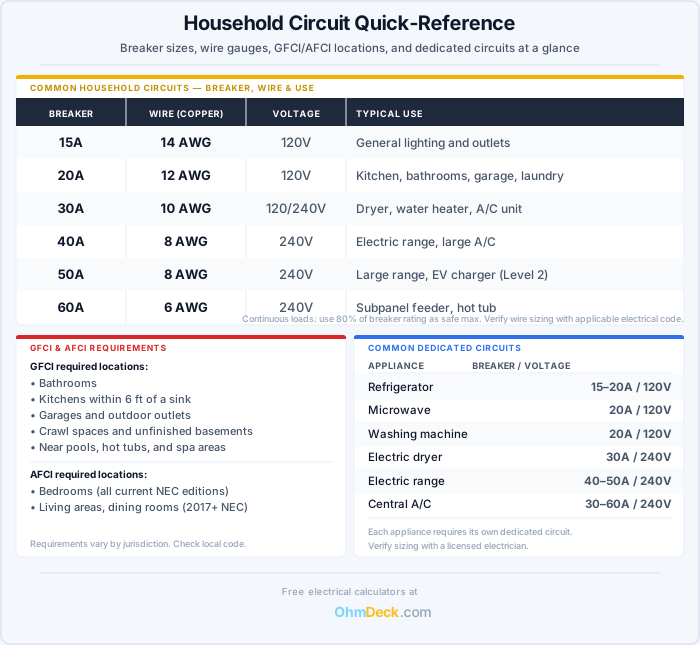
| Breaker size | Common voltage | Typical wire size | Common uses | Breaker type |
|---|---|---|---|---|
| 15A | 120V | 14 AWG copper | Bedroom outlets, lighting, general living-area circuits | Single-pole |
| 20A | 120V | 12 AWG copper | Kitchen small-appliance circuits, bathrooms, garages, laundry receptacles | Single-pole |
| 30A | Usually 240V in homes | 10 AWG copper | Electric dryers, some water heaters, some dedicated equipment circuits | Usually double-pole |
These are common residential baselines. Older homes, aluminum wiring, conduit runs, or special equipment instructions can change the details.
What a breaker actually protects
A breaker is there to stop a wire from carrying more current than that circuit was designed to handle. If current rises too high, the wire heats up. Too much heat can damage insulation, loosen connections, and create fire risk inside walls or devices.
That is why breaker size and wire size are paired together. A 15A breaker belongs with a circuit designed for 15A. A 20A breaker belongs with a circuit designed for 20A. A 30A breaker belongs with a heavier dedicated circuit. If the breaker is oversized for the conductor, the wire can overheat before the breaker trips.
15A vs 20A vs 30A in practical terms
15A circuits
A 15A breaker is the standard starting point for many general-purpose 120V household circuits. Bedrooms, living rooms, and lighting circuits often land here. On paper, 120 x 15 = 1800W, but real-world trip behavior depends on what else is already running on the same circuit.
A space heater, hair tool, or vacuum can use most of a 15A circuit by itself. That is why these circuits are more likely to trip when several medium loads stack up at once.
20A circuits
A 20A breaker still serves a 120V circuit, but it supports more current when the wiring and devices are designed for it. This is common in kitchens, bathrooms, garages, and laundry areas where higher-draw appliances are more routine. The simple watt math is 120 x 20 = 2400W.
That extra headroom helps with toasters, microwaves, hair dryers, and tools, but it does not mean you can swap a 15A breaker for a 20A breaker without checking the wire first.
30A circuits
In most homes, a 30A branch circuit is usually a 240V double-pole circuit for a dedicated load such as an electric dryer or some water heaters. On paper, 240 x 30 = 7200W. A double-pole breaker connects to two hot legs, spans both legs of the panel, and trips both poles together.
For normal residential planning, 30A most often means a dedicated 240V appliance circuit rather than a standard receptacle circuit.
Why you cannot just "upgrade" a breaker
If a circuit keeps tripping, the answer is not to install a larger breaker and hope it stops. The breaker size has to match the conductor size, circuit layout, and intended load. Replacing a 15A breaker with a 20A breaker on 14 AWG wiring removes the protection the wiring depends on.
The safer fixes are to reduce the load on that circuit, move heavy devices to a different circuit, or add a properly sized dedicated circuit.
Why breakers trip
Most homeowner trip situations fall into two buckets: overloads and faults.
- Overload: too many amps are being drawn for too long. Example: a 1500W space heater, vacuum, and TV all running on the same 15A living-room circuit.
- Short circuit or fault: current jumps suddenly because hot touches neutral, ground, or damaged wiring. Example: a pinched cord, failing appliance, or loose connection.
If a breaker trips once after an obvious overload, resetting it may be enough. If it trips repeatedly with a normal load, that is a troubleshooting problem, not just a reset problem.
Single-pole vs double-pole, where it matters
A single-pole breaker controls one hot leg and is the normal choice for standard 120V household branch circuits. A double-pole breaker controls two hot legs, spans both legs of the panel, and trips both poles together. That is what makes it the normal choice for most 240V residential circuits.
For a deeper breakdown, see Single-Pole vs Double-Pole Breaker.
Related tools and guides
FAQ
How many watts can a 15A circuit handle?
The simple nameplate math is 120 x 15 = 1800W. In real use, how much headroom you have depends on whether the load is continuous and what else is already on that circuit.
Why does my breaker trip when I run multiple appliances?
You are probably overloading the circuit. Several moderate loads on the same 15A or 20A branch circuit can add up fast, especially heaters, microwaves, hair dryers, and vacuums.
Can I replace a 15A breaker with a 20A breaker?
Not unless the entire circuit is wired and designed for 20A. In most homes, that means verifying 12 AWG copper or an equivalent conductor setup that supports a 20A breaker. If the circuit uses 14 AWG wiring, keep the 15A breaker.
Does a breaker protect the appliance?
Not primarily. The breaker is there to protect the branch-circuit wiring from overheating. Many appliances also have their own internal protection, but that does not change the breaker's job.
Does a 30A breaker always mean 240V?
No, not always. But in typical residential panel planning, a 30A breaker most often serves a dedicated 240V load through a double-pole breaker, such as an electric dryer or similar equipment.
Disclaimer: Results are informational estimates for learning and planning only. Always follow the applicable electrical code and consult a qualified licensed electrician for safety-critical work.