Ohm's Law Calculator (V / I / R / P)
Quick explanation
Use this calculator to solve for Voltage (V), Current (I), Resistance (Ω), or Power (W). Select what you want to solve for, then enter the two known values. For power, choose the pair you know (V×I, I²R, or V²/R) to avoid ambiguity. Pair this with the Amps to Watts calculator for quick watts checks from known volts and amps. Not familiar with the fundamentals yet? Start with Electricity Basics.
Select calculator mode:
Select what you want to solve for, then enter the two required values.
Tip: Choose what you want to solve for, then enter the two known values.
Using formula: I = V / R
Required inputs: Voltage (V), Resistance (Ω).
Need help choosing? See all formulas below.
Estimated current: 2 A
Enter 2 to 4 known values. Known inputs are highlighted in yellow, and computed outputs are filled in green.
Enter at least 2 known values.
Consistency tolerance: about 1% of the entered value (minimum ±0.02 in each unit).
Computed values: —
Formulas used: —
Power Triangle and Core Formulas
Use this quick reference when you know any two values and need the third. Start by identifying which value is missing, then choose the matching formula. Resistance formulas are included below for full V/I/R/P checks.
What the letters mean
P = Power (watts): Power is the rate of energy use. It is the number on appliance labels and your electricity bill.
V = Voltage (volts): Voltage is the electrical push that drives current through a circuit. Standard outlets in North America supply 120V.
I = Current (amps): Current is how much electrical flow is moving through the circuit. Wire gauge and breaker ratings are based on amps.
R = Resistance (ohms): Resistance is how strongly a material or component opposes current flow.
-
P = V × IUse this when you know voltage and current, but need watts.
What it tells you: the power consumed by a device running at that voltage and current.
-
I = P / VUse this when you know watts and voltage, but need amps.
What it tells you: the current draw of an appliance, so you can check it against your circuit breaker rating.
-
V = P / IUse this when you know watts and amps, but need voltage.
What it tells you: the voltage a circuit must supply to deliver that power at that current.
Power formulas
P = V × I(use when voltage and current are known)P = I² × R(use when current and resistance are known)P = V² / R(use when voltage and resistance are known)
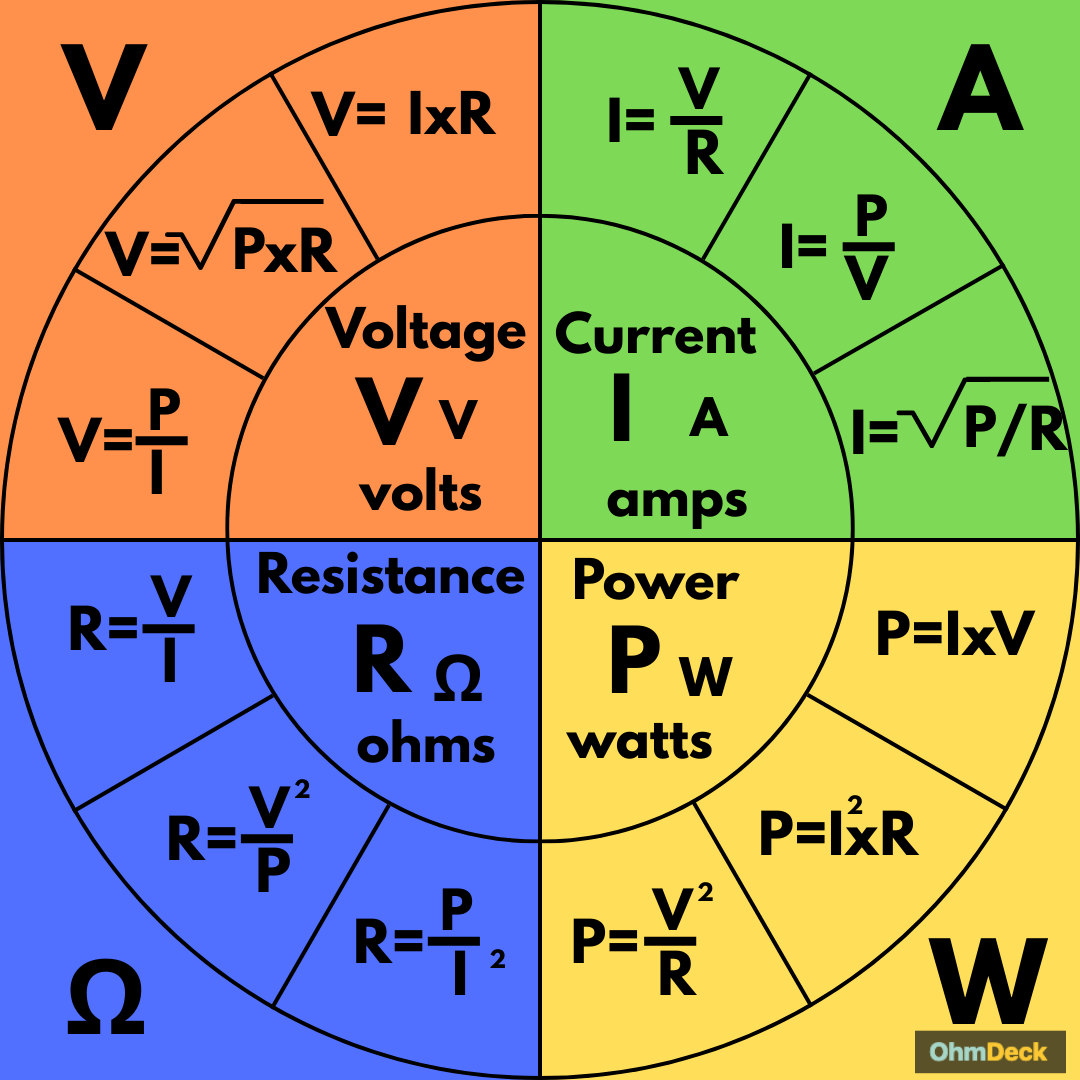
All calculator formula paths
- Current (I):
I = V / R,I = P / V,I = √(P / R) - Voltage (V):
V = I × R,V = P / I,V = √(P × R) - Resistance (R):
R = V / I,R = V² / P,R = P / I² - Power (P):
P = V × I,P = I² × R,P = V² / R
3 quick worked examples
- Example A (solve for current): V = 12V, R = 6Ω. Substitution:
I = V / R = 12 / 6. Final answer: I = 2A. - Example B (solve for voltage): I = 3A, R = 8Ω. Substitution:
V = I x R = 3 x 8. Final answer: V = 24V. - Example C (solve for resistance): V = 9V, I = 0.5A. Substitution:
R = V / I = 9 / 0.5. Final answer: R = 18Ω.
Power worked examples
- Example D: V = 120V, I = 12.5A.
P = V × I = 120 × 12.5. Final answer: 1500W. - Example E: I = 2A, R = 6Ω.
P = I² × R = 2² × 6. Final answer: 24W. - Example F: V = 9V, R = 18Ω.
P = V² / R = 9² / 18. Final answer: 4.5W.
Note: These are ideal DC-style relationships for quick checks. Real measured values can differ because of load changes, meter accuracy, temperature, wiring losses, and component tolerance.
Ohm’s Law Formula Wheel (V / I / R / P)
This wheel is a quick reference that links voltage, current, resistance, and power in one view. Use it alongside the triangle above when you want to switch between base Ohm's Law checks and power equations.
It complements the triangle and adds power formulas.
Common Household Situations
- Space heater: 1500W @ 120V ≈ 12.5A (1500 ÷ 120). Adding other high-watt devices on a 15A circuit can trip the breaker.
- Hair dryer: 1875W @ 120V ≈ 15.6A.
- Microwave: 1200W @ 120V ≈ 10A (plus other loads on the same circuit).
- Kettle or toaster: 1500W @ 120V ≈ 12.5A.
Safety reminder: use these as planning checks and verify final decisions against code, nameplate ratings, and licensed professional guidance.
FAQ
What is Ohm's Law?
Ohm's Law is V = I x R.
Can this replace field testing?
No. It is a planning and learning tool, not a substitute for measurements.
Can this calculator solve for power?
Yes. Use the Solve for selector and pick Power (P), then choose the matching formula path.
Why are my measured values different?
Temperature, wiring conditions, and load changes can shift real values.
Related calculators
Assumptions (planning-only)
- Assumes steady-state DC-style relationships for baseline calculations.
- Complex AC effects and harmonics are outside this simplified model.
- Use professional judgment for safety-critical design decisions.
⚠️ Sanity Check Only
This tool provides informational estimates only. It is not professional engineering advice. Electrical work is dangerous and governed by strict local codes.
Before you start:
- Verify these results with a licensed electrician.
- Cross-reference with the latest Electrical Code (NEC/CEC).
- Never work on live circuits.