Can I Upgrade a 15 A Breaker to 20 A?
The short answer
- It depends entirely on the wire gauge in the circuit.
- If the circuit is wired with 12 AWG wire: upgrading to a 20 A breaker may be appropriate.
- If the circuit is wired with 14 AWG wire: do not upgrade the breaker. The wire cannot safely handle 20 A.
- Swapping the breaker without verifying wire gauge removes the protection the wiring depends on.
Why the breaker rating must match the wire gauge
A circuit breaker does not protect the devices plugged into the circuit, it protects the wiring. When more current flows through a wire than it was designed to carry, the wire heats up. Enough heat can damage insulation, cause arcing, and start a fire inside a wall where you cannot see or smell it until it is too late.
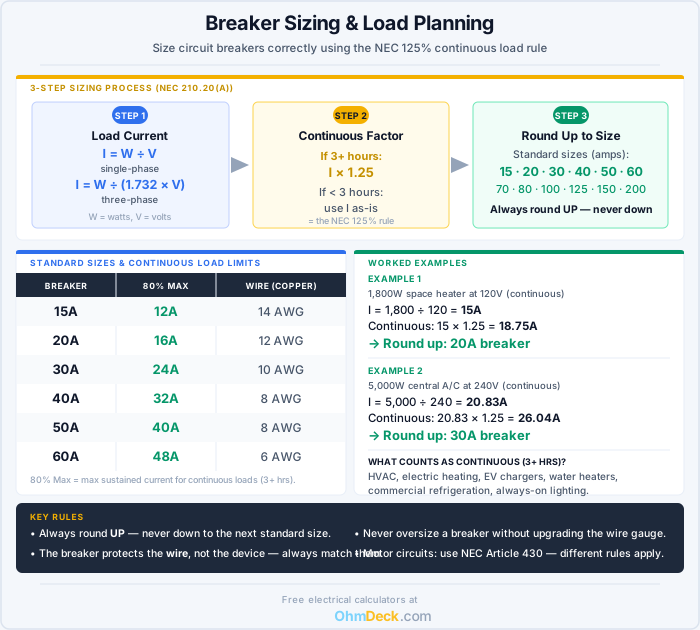
The relationship is direct: 14 AWG wire is rated to carry 15 A continuously. 12 AWG wire is rated to carry 20 A continuously. The breaker is sized to trip before the wire reaches its thermal limit. A 20 A breaker on 14 AWG wire will allow the wire to carry loads it was not designed for, and it won't trip until the current exceeds 20 A, long after the 14 AWG has already been stressed beyond its rating.
This is not a theoretical risk. Wiring fires from oversized breakers are a documented cause of structure fires.
How to check your wire gauge
Wire gauge is marked on the cable sheathing, look for text like "14-2 NM-B" or "12-2 NM-B". The first number is the gauge. Smaller numbers mean thicker wire: 12 AWG is thicker than 14 AWG.
Where to check:
- Inside the electrical panel, where the cable connects to the breaker
- In the attic or basement, where the cable runs are visible
- Inside an outlet box, turn off power first and pull the outlet slightly to see the cable entering the box
If the cable is old cloth-wrapped wiring, aluminum wiring, or you cannot identify the gauge with confidence, stop and consult a licensed electrician before making any changes.
Wire gauge vs ampacity reference
| Wire gauge (AWG) | Max ampacity (NM cable, 60°C) | Standard breaker size | Can use 20 A breaker? |
|---|---|---|---|
| 14 AWG | 15 A | 15 A | No |
| 12 AWG | 20 A | 20 A | Yes |
| 10 AWG | 30 A | 30 A | N/A (oversized for 20 A) |
Ampacity values are for NM (non-metallic sheathed) cable in typical residential use. Conduit and other wiring methods may have different ratings.
When upgrading to 20 A actually makes sense
If you verify the circuit is wired with 12 AWG wire throughout, then upgrading the breaker from 15 A to 20 A is reasonable, the wiring supports it. This is sometimes found in older homes where 12 AWG was run but a 15 A breaker was installed (often for conservative sizing or because the original loads were light).
But "makes sense" does not mean "drop in a new breaker and you are done." You should also verify:
- All outlets and devices on the circuit are rated for 20 A (or at least that no device will draw close to 20 A continuously)
- The circuit does not share a neutral with another circuit in a way that could cause issues at higher current
- Local electrical code allows the change without a permit, in some jurisdictions, any panel work requires a permit and inspection
The right fix for an overloaded circuit
If your 15 A circuit keeps tripping because you are running too much on it, the correct solution is usually one of these:
- Redistribute loads: move some devices to a different circuit that has headroom.
- Add a dedicated circuit: have an electrician run new 12 AWG wiring with a 20 A breaker for the high-draw device.
- Upgrade the circuit wiring: replace the 14 AWG with 12 AWG and then install the 20 A breaker. This is proper and safe but requires more work than just swapping a breaker.
What is never the right fix: installing a 20 A breaker on 14 AWG wiring to stop the tripping. That eliminates the protection without solving the problem.
Related tools and guides
- Why Does My Breaker Keep Tripping?
- How Circuit Breakers Work
- How Many Watts Is a 15 A Circuit at 120 V?
- Watts-to-Amps Calculator, check your load against circuit capacity
- Electricity Basics
FAQ
My breaker keeps tripping. Can I just swap it for a 20 A?
Only if the circuit is wired with 12 AWG wire throughout. If the wiring is 14 AWG, which is the case for most 15 A circuits, installing a 20 A breaker removes the protection the wiring depends on. The correct fix is to either reduce the load, redistribute it to another circuit, or have an electrician add a properly wired dedicated circuit.
How do I know if my circuit is 14 AWG or 12 AWG?
Check the cable label inside the panel, at outlet boxes, or where the wire is exposed in an attic or basement. "14-2" means 14 AWG; "12-2" means 12 AWG. If you cannot find or read the label, have an electrician check, guessing wrong is not worth the risk.
Is 12 AWG wire always safe for 20 A?
In typical residential NM cable applications, yes, 12 AWG is rated for 20 A. However, wire routing, insulation type, conduit fill, and temperature can affect ampacity in some cases. When in doubt, follow local electrical code or consult an electrician.
Do I need a permit to replace a breaker?
Permit requirements vary by jurisdiction. Some areas allow homeowners to replace a like-for-like breaker without a permit; others require permits for any panel work. Check with your local building department before doing panel work. Getting a permit also means an inspector will verify the work is correct, which is worth having for electrical work.
What if some of the circuit is 12 AWG and some is 14 AWG?
The entire circuit must be rated for 20 A to use a 20 A breaker safely. If any segment of the circuit, even a short one, is 14 AWG, the whole circuit must stay at 15 A. The weakest link in the wiring sets the safe current limit for the whole circuit.
Disclaimer: Results are informational estimates for learning and planning only. Always follow the applicable electrical code and consult a qualified licensed electrician for safety-critical work.