How to Find Appliance Wattage
Quick answer
- Check the nameplate first, a label on the back, bottom, or inside door lists wattage, amps, and voltage.
- The EnergyGuide label on refrigerators, washers, and dishwashers shows annual kWh use, not peak wattage.
- Can't find watts? If the label shows amps and volts, calculate:
W = A × V. - Measured wattage from a plug-in energy monitor is the most accurate method.
Method 1: The nameplate (most reliable)
Every appliance sold in the US has a nameplate, a permanent label applied by the manufacturer. It typically lives on the back of the device, on the bottom, inside a door or compartment, or on the power cord near the plug. For built-in appliances like dishwashers and ranges, check inside the door frame.
What to look for on the nameplate:
- Watts (W): The clearest number, use this directly.
- Amps (A) + Volts (V): If watts is not listed, multiply them:
W = A × V. For example, "12A 120V" = 1440 W. - VA: Volt-amps, essentially equivalent to watts for resistive loads. Use it as an estimate.
Important: the nameplate shows the maximum or rated draw. A device may draw less during normal operation. Microwaves and refrigerators are good examples; the nameplate wattage is the peak, not the average.
Method 2: The EnergyGuide label
The yellow EnergyGuide label appears on refrigerators, freezers, dishwashers, washing machines, water heaters, air conditioners, and a few other major appliances. It is required by the FTC and shows estimated annual energy use in kWh, useful for understanding running cost, but not the same as peak wattage.
To estimate average wattage from an EnergyGuide label:
Average W = (kWh per year × 1000) ÷ hours per year
Example: A refrigerator that uses 400 kWh/year runs about 8760 hours/year, so average draw = (400 × 1000) ÷ 8760 ≈ 46 W average. But the compressor peaks much higher when cycling; the nameplate wattage is still what to use for circuit planning.
Method 3: Product specification sheet or manual
The owner's manual (or the product page on the manufacturer's website) usually lists electrical specifications including wattage, amperage, and voltage requirements. Search for the model number followed by "specs" or "datasheet."
This is especially useful for tools and workshop equipment where the nameplate may be hard to read or worn. The model number is typically on the same nameplate; note it down before looking up the spec sheet.
Method 4: Plug-in energy monitor (most accurate for actual draw)
A plug-in energy monitor (such as a Kill-A-Watt meter) plugs between the outlet and the appliance and measures real-time watts, amps, volts, and cumulative kWh. For appliances with variable draw (refrigerators, air conditioners, devices with standby modes), this is the most accurate way to understand what the device actually pulls under real conditions.
A typical energy monitor costs $15–30 and can pay for itself quickly if you use it to identify high-draw devices on your bill.
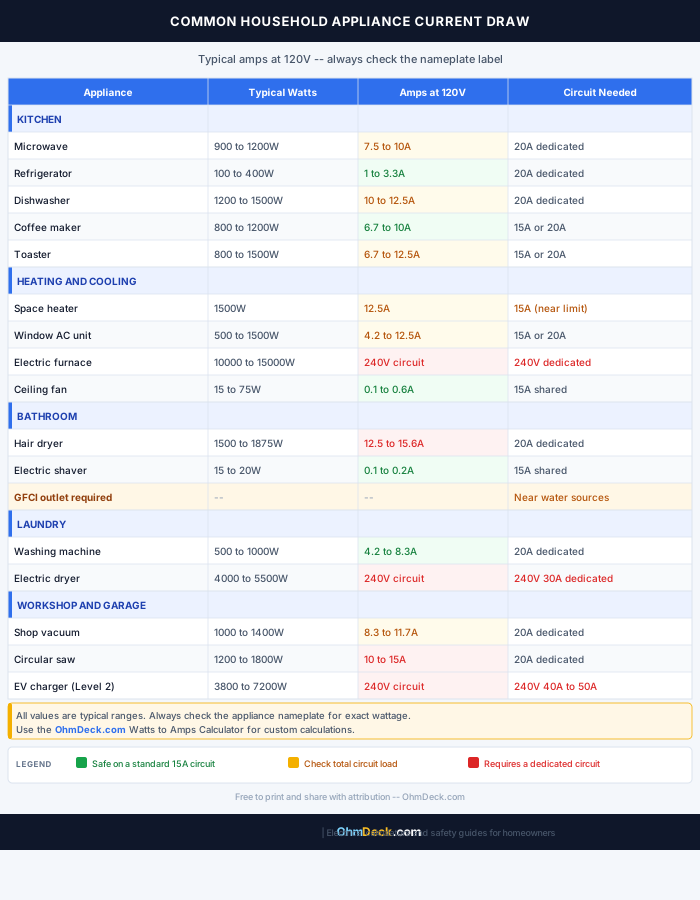
Reference table: typical wattage ranges by appliance type
| Appliance | Typical wattage (nameplate) | Notes |
|---|---|---|
| LED bulb | 5–15 W | Constant draw |
| Laptop charger | 45–100 W | Varies with load |
| Refrigerator | 100–400 W | Cycles on/off; average much lower |
| Microwave (1000 W rated) | ~1400 W input | Output ≠ input; use nameplate amps |
| Space heater | 750–1500 W | Often has low/high settings |
| Window AC (5000 BTU) | ~500 W | Cycles; EnergyGuide shows annual kWh |
| Electric dryer | 5000–6000 W | Heating element dominates |
| Electric range element | 1200–3000 W per burner | Check each element separately |
When wattage is not what you think
Microwaves: The advertised wattage (e.g., "1000 W microwave") is the output cooking power. The input wattage drawn from the wall is typically 30–40% higher, around 1400–1600 W for a 1000 W microwave. Always use the nameplate input wattage for circuit planning.
Devices with variable load: Refrigerators, air conditioners, and devices with standby modes cycle between a high draw (compressor or heating element running) and near-zero (standby). The nameplate shows the peak; average use is much lower. For circuit planning, size for the peak. For energy cost estimates, use the EnergyGuide kWh figure or a measured average.
Startup surge: Motors (air conditioners, refrigerators, power tools) draw 3 to 8 times their running wattage for a fraction of a second at startup. This usually doesn't trip breakers but is worth knowing for generator sizing and certain battery/inverter setups. If you are planning backup power, compare Running Watts vs Starting Watts, then try the Generator Wattage Calculator or the scenario pages for a refrigerator, a refrigerator and freezer, or a sump pump.
Related tools and guides
- Generator Wattage Calculator, turn label watts into a practical backup-power starting point
- Running Watts vs Starting Watts, understand why motors can need more generator headroom than the steady load suggests
- What Size Generator for a Refrigerator?, apply those watt numbers to a fridge-only outage plan
- What Size Generator for a Refrigerator and Freezer?, plan for two cold-storage loads without double-counting the wrong way
- What Size Generator for a Sump Pump?, focus on motor startup and wet-weather reliability
- kWh Calculator, estimate energy use from wattage and runtime
- Electricity Cost Calculator, turn kWh into dollars
- Watts-to-Amps Calculator, convert nameplate watts to amps for circuit checks
- How to Read Your Electric Bill
- Why Is My Electric Bill So High?
- Electricity Basics: Voltage, Current, and Resistance
FAQ
What if the nameplate only shows amps, not watts?
Multiply amps by voltage: W = A × V. For a standard US outlet, voltage is 120 V. For large appliances (dryers, ranges), voltage is 240 V. For example, "10A 120V" = 1200 W. Note this gives the maximum rated draw, actual draw may be lower.
The label shows VA, not watts. Can I use that?
For most household resistive loads (heaters, toasters, straightforward electronics), VA ≈ watts because power factor is close to 1. For motors and some devices with reactive components, actual watts will be lower than VA. Using VA as a planning estimate is conservative, it won't undersize your circuit.
Why is my microwave's input wattage different from its "1000 W" rating?
The "1000 W" rating refers to cooking output power, the energy delivered to the food. The magnetron and other components are not 100% efficient, so the wall draw (input) is higher. Check the nameplate for the actual input watts (usually listed as "Input Power" or "Rated Input") to size circuits correctly.
Can I use an online database to find appliance wattage?
Yes, the ENERGY STAR product database and the Lawrence Berkeley National Laboratory's Home Energy Saver tool list typical wattages for many common appliances. These are useful for general estimates when you don't have the nameplate available, but the actual nameplate on your specific model is always more reliable.
My appliance is old and the nameplate is unreadable. What now?
Search for the model number (often on a separate label or inside a door) online. Failing that, use a plug-in energy monitor to measure actual draw directly. As a last resort, use the typical wattage range for that appliance type as a planning estimate, but be conservative and round up.
Disclaimer: Results are informational estimates for learning and planning only. Always follow the applicable electrical code and consult a qualified licensed electrician for safety-critical work.